
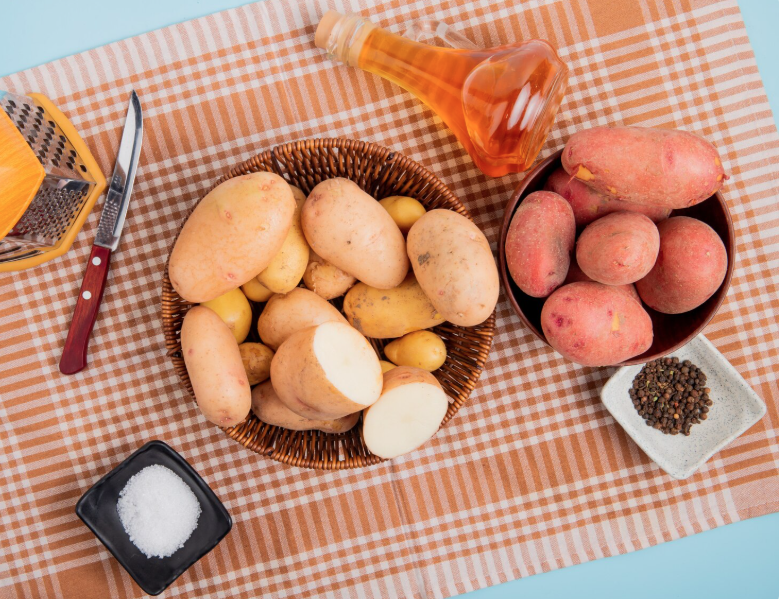
One of the most adaptable items in daily cookery is potatoes. You may boil, bake, roast, mash, fry, or incorporate them into salads and soups. But not every potato reacts to heat in the same way. After boiling, some become soft and fluffy, while others stay rigid. Some are appropriate for a variety of recipes since they lie in the middle of these two textures.
Knowing the distinctions between floury, waxy, and all-purpose potato varieties may make selecting the best one for a certain cooking technique much simpler. Starch, moisture, and texture are the main factors that make the difference.
Waxy Potatoes: What Are They?
In general, waxy potatoes have more moisture and comparatively less starch. They often have solid, thick, and smooth flesh. Their ability to keep their form while cooking is one of their best features.
Because of this, waxy potatoes are especially well suited for recipes where individual potato pieces must stay whole. Boiling, steaming, or adding them to salads, soups, and casseroles all work nicely. When potatoes need to be sliced either before or after cooking, their solid texture might be helpful.
Waxy potatoes are often less appropriate when a very light and fluffy mash is desired since they are difficult to break apart. Recipes that benefit from hardness and structure are better suited to their texture.
Floury Potatoes: What Are They?
On the other extreme of the textural range are floury potatoes. Compared to waxy kinds, they usually have less moisture and more starch. Their flesh turns fluffy, dry, and tender after cooking.
Because of these characteristics, floury potatoes are a great option for baking, roasting, mashing, and certain fried dishes. When mashed, their starchier core may efficiently absorb butter, milk, spices, and other ingredients.
Floury potatoes may have a crisp outside and a mushy interior when baked or roasted. However, if they are cooked for an extended period of time, their fragile texture may cause them to fall apart. They are thus not always the best option for recipes that call for precisely defined potato pieces.
Instead of just utilizing whichever potatoes happen to be available, chefs may produce more consistent outcomes from many potato varieties by learning these fundamental traits.
What Is The Place Of All-Purpose Potatoes?
All-purpose potatoes, as their name implies, provide a harmony between floury and waxy qualities. They have a delightfully soft feel when baked or mashed, but they have adequate structure for boiling since their starch and moisture levels are usually in the center.
For homes that don’t want to have many types of potatoes on hand, their adaptability makes them very practical. In addition to many other common preparations, they may be used for roasting, boiling, baking, mashing, soups, and stews.
An all-purpose potato offers versatility even if it may not always have the precise texture of a more specialized kind. That balance might be more useful for general cooking than a potato made just for one method.
The Significance Of Starch Content
When potatoes are cooked, starch has a significant impact on what happens to them. As they cook, potatoes with more starch tend to soften and separate more easily. The denser structure of lower-starch potatoes aids in their cohesiveness.
Another crucial element is moisture. Whether a cooked potato feels fluffy, creamy, solid, or dense depends on the ratio of starch to moisture.
Common culinary disappointments may be avoided by being aware of these distinctions. A highly floury potato may make a salad too soft, whereas a very waxy potato can make mashed potatoes seem heavier.
Selecting The Proper Potato For Your Recipe
The simplest method of selecting a potato is to consider the desired end texture. Waxy potatoes are often a preferable option for recipes that call for potatoes to stay firm and defined. Floury potatoes are often more suited for baking, crispy roasting, and fluffy mash. All-purpose potatoes provide a useful compromise where adaptability is crucial.
Much of the uncertainty in cooking is eliminated when one is aware of the characteristics of several potato varieties. Choosing potatoes based on their texture and cooking technique might enhance the final product rather than seeing them as interchangeable. The appropriate kind may make a big impact, whether the objective is crisp roasted potatoes, creamy mash, or hard potato salad.
