
At home, vaping runs on autopilot: the kit lives in one pocket, the spares in one drawer, and the rules of every familiar space are already mapped. Travel breaks all of it at once. Suddenly there are airline battery regulations, security liquid limits, hotel policies, foreign laws ranging from relaxed to genuinely criminal, and the logistical puzzle of keeping a habit supplied for a fortnight from a suitcase. Every year, travelling vapers have devices confiscated, liquids binned at security, and — in a small number of countries — far worse, almost always through simple unawareness rather than defiance. This guide is the complete travel module: packing and flying correctly, navigating airports and hotels, researching destination law properly, managing supply abroad, and the road-trip and ferry variations. Knowing how to vape covers you at home; this covers the other weeks of the year.
The One Unbreakable Flight Rule
Start with the rule that has no exceptions anywhere in world aviation: vaping devices and all spare batteries travel in cabin baggage, never in the hold. This is battery physics, not vaping politics — lithium cells in rare failure produce fires that cabin crews can fight and cargo holds cannot — and airlines enforce it absolutely; devices found in checked luggage are removed, delayed or confiscated. The corollaries: never charge a device on board, never use it on board (aircraft toilets have detectors and tampering with them is a criminal offence in most jurisdictions, with fines that ruin holidays), and pack it switched off or locked where the hardware allows. Carry the device as you would carry your phone: on your person or in the bag at your feet, and forgotten until landing.
Liquids, Pods and the Security Line
E-liquid is a liquid, and airport security treats it as one: bottles and filled pods in cabin baggage must sit inside the standard liquids allowance — containers up to 100ml in the clear resealable bag, a limit UK e-liquid trivially satisfies since bottles are capped at 10ml anyway. Checked luggage can carry larger liquid quantities where you have them, well-sealed against pressure seepage (a zip bag saves a suitcase). Two practical refinements: fly with tanks and refillable pods mostly empty or lightly filled, because cabin pressure changes push liquid out of full ones — the classic arrival-gate leak — while sealed prefilled pods handle pressure far better; and keep everything visible and unremarkable at screening, since a bag of clearly labelled retail products sails through where a pouch of unlabelled bottles invites questions. Nothing about flying with vape gear is difficult; it is merely specific.
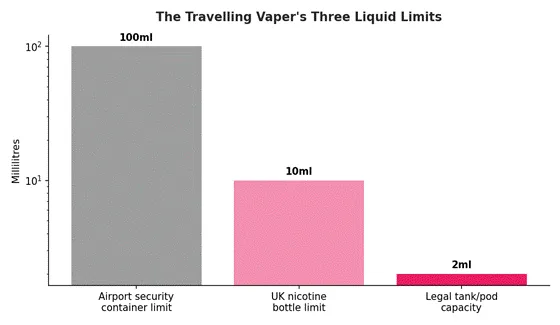
The travelling vaper’s liquid maths — the three limits that govern what goes where.
Researching Your Destination Like It Matters
Because it does. The world’s vaping laws span the full spectrum: broadly permissive regimes like the UK and most of Europe; regulated-but-legal markets with quirks (some countries restrict nicotine liquid specifically, or sales but not possession); and a shortlist of destinations where vaping products are banned outright, with penalties that range from confiscation and fines to, in the sternest cases, detention — several popular holiday destinations in Asia and the Middle East sit in this last category, and tourists are not exempt. The research protocol before any trip: check your destination’s current official guidance — the UK Foreign Office travel advice pages cover vaping rules for many countries — plus any transit stops, since a banned-country layover with gear in your cabin bag is still possession; and check recency, because these laws move. The iron rule when the answer is a ban: do not bring it, at all, hidden or otherwise — no habit is worth a holiday spent explaining yourself to customs. For those destinations, speak to a pharmacist about nicotine patches or gum for the duration; a fortnight on an alternative beats every version of the gamble.
Hotels, Apartments and Other People’s Property
Accommodation runs on policy, not law, and the safe default is that every indoor rented space is no-vape unless expressly stated otherwise. Hotels increasingly write vaping into the same clause as smoking, with the same cleaning fees, and while vapour is far less likely than smoke to trigger a room’s detector, ‘less likely’ is doing risky work in a sentence about a £150 charge — balconies, courtyards and designated areas are the travelling vaper’s territory. Holiday apartments and homestays: ask the host directly; the question costs nothing and the goodwill is worth more than the puff. The travel-specific habit worth forming: scope your vaping geography on arrival — where outside is comfortable, where the smoking area lives — exactly as smokers always did, so the habit has a home before the first craving asks.
Supply Logistics: Pack Like a Quartermaster
Nothing degrades a trip like hunting an unfamiliar city for compatible pods on day three. The arithmetic: audit your true daily consumption honestly, multiply by trip length, add fifty percent for holiday drift (relaxed days run higher), and pack that — in cabin and checked split, so no single mishap strands you. Bring the charging lead and a plug adapter; bring a spare device if you own one, because abroad is the worst place to discover a failure; and favour your most travel-proof format — sealed prefilled pods tolerate heat, pressure and jostling better than open tanks, and remove the airport-liquid choreography almost entirely. Buying abroad is the fallback, not the plan: your brand may not exist there, counterfeits concentrate in tourist zones, and strengths and standards differ — the EU shares the UK’s 20mg ceiling, but elsewhere labels mean different things. Stock up properly at home before departure — a UK specialist such as pink vape covers travel-friendly formats and multi-buy bundles that make the pre-trip order cheap — and the entire category of holiday vape-shopping stress disappears.
Heat, Beaches and the Holiday Environment
Destinations bring environments the kit was not stored for at home. Heat is the main character: a device or liquid left in a parked hire car, a beach bag in direct sun, or a windowsill in a hot climate will thin, seep and degrade — the travel rules are shade, never the car, and somewhere cool overnight. Sand is the quiet assassin of airflow inlets and charging ports; a simple case or zip bag earns its space in any beach context. Water needs no elaboration beyond the reminder that pockets forget: patting for the device before the sea joins wallet-and-phone ritual. And altitude briefly matters for tank users — pressure changes on mountain drives push liquid like flights do — while sealed pods again shrug. None of this is delicate-flower stuff; it is the same care as sunglasses, applied to electronics full of liquid.
Road Trips, Ferries and Trains
The overland variations, quickly. Driving: vaping while driving is legal for adults in the UK, but a windscreen full of exhale is a genuine visibility hazard the police can treat as careless driving — crack the window, exhale low and away, or wait for the stop; and never leave the kit in the parked car, per the heat rule. Hire cars abroad: assume no-vape unless the contract says otherwise; the smell-and-residue clause reads the same in every language. Ferries: enclosed decks follow indoor rules, open decks are usually designated-area territory — signage governs. International trains: banned on board across effectively all operators, toilets included and monitored; platforms vary by country, so follow locals and signs. The unifying principle across every mode: transport operators set their spaces’ rules absolutely, and the vaper who checks before assuming travels unbothered.
The Pre-Trip Checklist
The whole guide, compressed for the night before. Law checked for destination and layovers, recently, from official sources — and the no-go destinations respected with a patch-and-gum plan instead. Device and every spare battery in cabin bag, off; liquids within the security allowance in the clear bag, larger reserves sealed in the hold; tanks travelling near-empty, prefilled pods as the workhorse. Consumption maths done with the fifty-percent holiday margin, supplies split across bags, lead and adapter packed, spare device if owned. Accommodation policy checked or a balcony confirmed. Case for sand and sun contexts. And the soft item that outranks the rest: the intention, formed in advance, to vape on arrival the way this whole series teaches — considerately, discreetly, and by the local rulebook, as a guest. Pack that, and the habit travels as lightly as everything else.
Travel FAQs
The recurring departure-lounge questions. Can I vape in the airport? Landside and airside terminals are no-vape by policy almost universally; some airports keep designated smoking areas that admit vapers — signage governs, and the pre-security session is the reliable one. What happens if I forget a device in my checked bag? Commonly the bag is searched and the device removed or the bag delayed — declare and repack at check-in if you remember in time. Do I need to remove pods from the device at security? Usually no; keep filled pods with your liquids bag if asked, and let the tray process run its course. Can I buy liquid at my destination and fly it home? Yes, within the same cabin/hold liquid rules — but check it against UK compliance on return, since stronger-than-20mg holiday purchases are non-compliant at home. What about vaping in transit countries during a layover? The strictest law you pass through applies to what is in your bag — route around banned jurisdictions or leave the kit at home. And cruise ships? Cabin bans are near-universal and balcony rules vary by line — the booking conditions answer, and designated deck areas are the safe default.
One last piece of travel wisdom from veterans: photograph your kit and keep receipts in your email. In the rare event of a customs question, a confiscation dispute or an insurance claim on a lost bag, thirty seconds of documentation converts an argument into an administrative detail — the same principle as photographing your passport, applied to the pocket that vapes.
The Bottom Line
Travelling as a vaper is a solved problem with a short syllabus: batteries fly cabin-side always, liquids obey the security bag, destination law gets researched like visas do, bans get respected without exception, accommodation defaults to no until asked, and supply gets packed rather than hoped for. An evening of preparation converts every travel horror story in this genre into a non-event, and the habit that supports you at home supports you identically on a terrace in the sun. The standing reminders travel too: adults 18 and over only, existing smokers and vapers only — and wherever in the world you take it, the same closing truth applies at every latitude: for anyone outside nicotine, the best travel kit is none.
